
5.8 KiB
Getting Started with ReactFire
⚛ + 🔥 = 🌯
This quickstart shows you how to connect your React web app to Cloud Firestore, listen for its data, and display the data in real time. We'll also configure Firebase Performance Monitoring so you can get some performance stats.
Let's build a web app that displays, in real time, the tastiness of a burrito. Yum!
To see the completed app, check out this StackBlitz workspace.
1. Create a document in Cloud Firestore
If your project doesn't have a Cloud Firestore database instance yet, check out these instructions to create a new instance. Please initialize it in locked mode.
-
Go to the Database tab in the Firebase console.
-
Add a document.
-
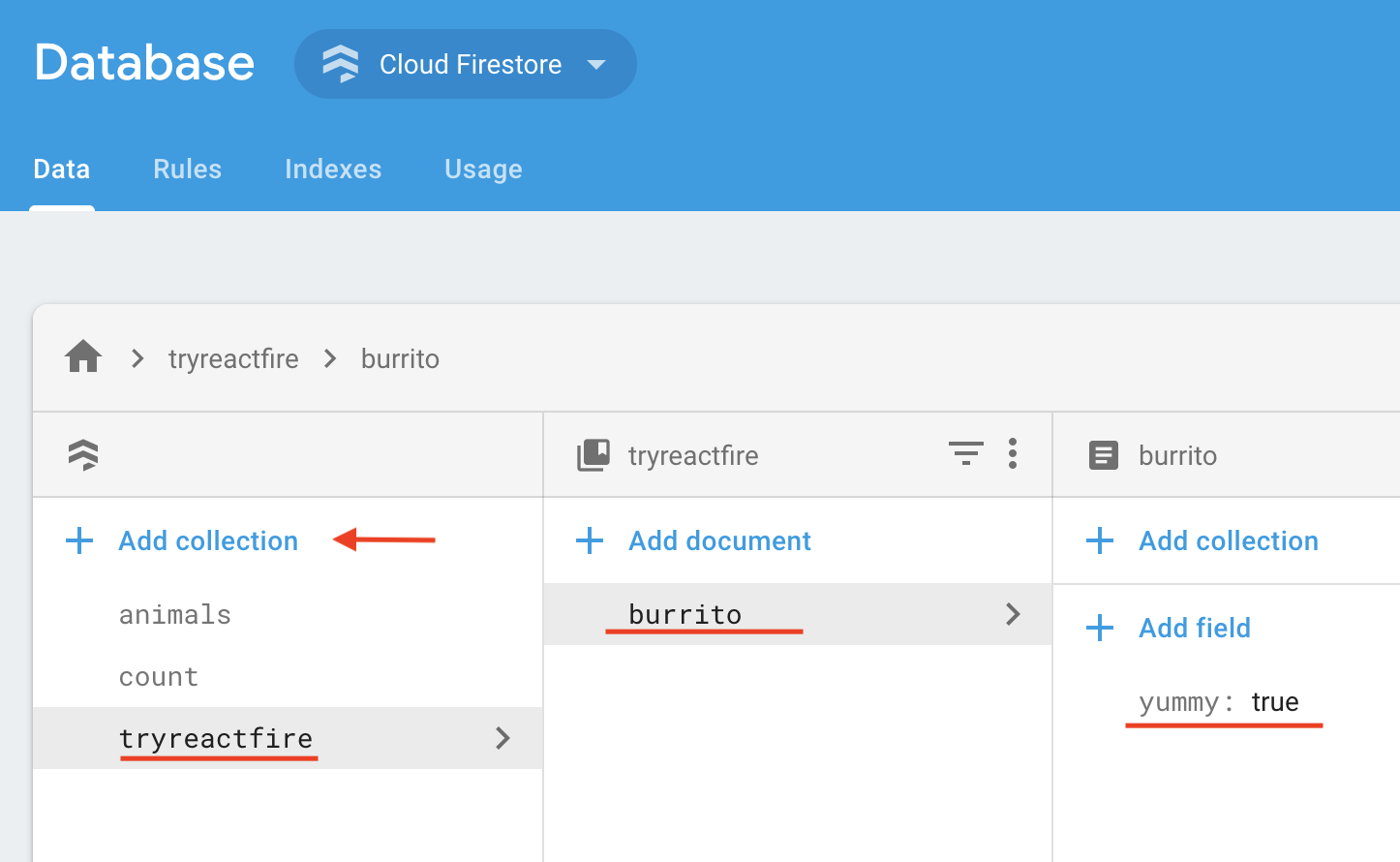
In the Data tab of the console, click Add Collection
-
Name the collection tryreactfire
-
Add a document with ID burrito and boolean field
yummy: true
-
-
Add security rules to your document.
- In the Rules tab of the console, add the following security rules:
rules_version = '2'; service cloud.firestore { match /databases/{database}/documents { match /tryreactfire/burrito { allow read, write: if true; } } }- Publish the rules.
2. Create a React App
Prerequisite: make sure you have Node.js installed.
In a terminal, create a fresh React app in a directory of your choice.
npx create-react-app myapp
cd myapp
3. Install ReactFire and the Firebase SDK
Ignore yarn/npm warnings.
yarn add firebase reactfire

# or

npm install --save firebase reactfire
4. Register your app with Firebase
-
In the center of the Firebase console's project overview page, click the Web icon to launch the setup workflow.
If you've already added an app to your Firebase project, click Add app to display the platform options.
-
Enter your app's nickname.
Note: Firebase Hosting is not required for you to use Firebase products with your web app.
-
Register the app.
-
Copy the Firebase configuration. This will be used in Step 4.
-
Continue to Console
5. Add Firebase to src/index.js
-
Import Firebase and ReactFire
//... import { FirebaseAppProvider } from 'reactfire'; //... -
Add the Firebase configuration
Add the firebaseConfig constant and paste the configuration from Step 3.
//... const firebaseConfig = { /* Paste your config object from Firebase console here */ }; //... -
Wrap your app in a
FirebaseAppProviderReplace the default render function.
//...
ReactDOM.createRoot(document.getElementById('root')).render(
 <FirebaseAppProvider firebaseConfig={firebaseConfig}>
   <App />
 </FirebaseAppProvider>
);
//...
6. Modify src/App.js
-
Import the
useFirestoreDocDataanduseFirestorehooks//... import { useFirestoreDocData, useFirestore } from 'reactfire'; //... -
Add a function component
//... function Burrito() { // lazy load the Firestore SDK and create a document reference const burritoRef = useFirestore() .collection('tryreactfire') .doc('burrito'); // subscribe to the doc. just one line! const burrito = useFirestoreDocData(burritoRef); // get the value from the doc const isYummy = burrito.yummy; return <p>The burrito is {isYummy ? 'good' : 'bad'}</p>; } //... -
Render your component inside of a
Suspensetag
We need to do this because
useFirestoreDocDatathrows a Promise while it is waiting for a response from Firestore. Suspense will catch the Promise and renderfallbackuntil the Promise is resolved.
Replace the App function with the following:
//...
function App() {
  return (
    <div className="App">
      {/*
        SuspenseWithPerf behaves the same as Suspense,
        but also automatically measures load times with the User Timing API
        and reports it to Firebase Performance Monitoring
      */}
      <SuspenseWithPerf
        fallback={'loading burrito status...'}
        traceId={'load-burrito-status'}
      >
        <Burrito />
      </SuspenseWithPerf>
    </div>
  );
}
//...
7. Run your app!
-
Run your app.
yarn start # or npm run start -
Edit the value of
yummyin the Database tab in the Firebase console and watch it update in real time in your app! 🔥🔥🔥
About Firebase Performance Monitoring
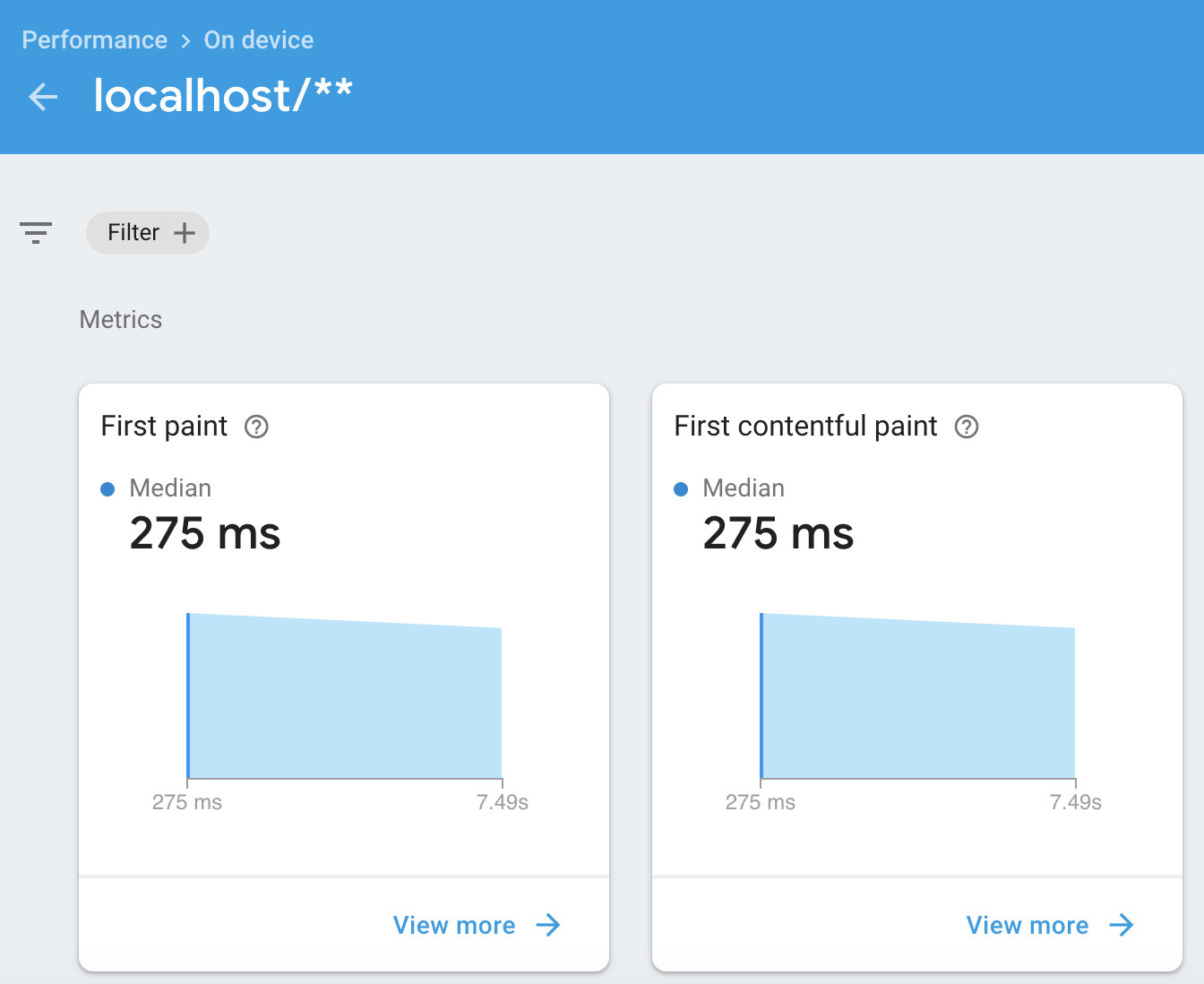
SuspenseWithPerf will lazy load the Firebase Performance Monitoring library and report on on our custom trace, load-burrito-status, that we set in the traceId prop of SuspenseWithPerf. In addition, it will automatically measure common performance stats!
Note that Firebase Performance Monitoring can take about 12 hours to crunch your data and show it in the Performance tab of the Firebase console.
This is an example of some of the stats in the Firebase Performance Monitoring console after 12 hours:
Next Steps
To explore information on using ReactFire, check out Common Use Cases.