mirror of
https://github.com/zhigang1992/probot.github.io.git
synced 2026-01-12 17:33:05 +08:00

2.8 KiB
2.8 KiB
title, description, slug, screenshots, authors, repository, host, stars, updated, installations, organizations
| title | description | slug | screenshots | authors | repository | host | stars | updated | installations | organizations | ||||||||||||
|---|---|---|---|---|---|---|---|---|---|---|---|---|---|---|---|---|---|---|---|---|---|---|
| Release Drafter | Drafts your next release notes as pull requests are merged into master. | release-drafter |
|
|
toolmantim/release-drafter | https://release-drafter.now.sh | 321 | 2018-12-19 13:01:21 UTC | 207 |
|
Usage
- Install the Release Drafter GitHub App into the repositories you wish to create releases in.
- Add a
.github/release-drafter.ymlconfiguration file to each repository.
Example
For example, take the following .github/release-drafter.yml file in a repository:
template: |
  ## What's Changed

  $CHANGES
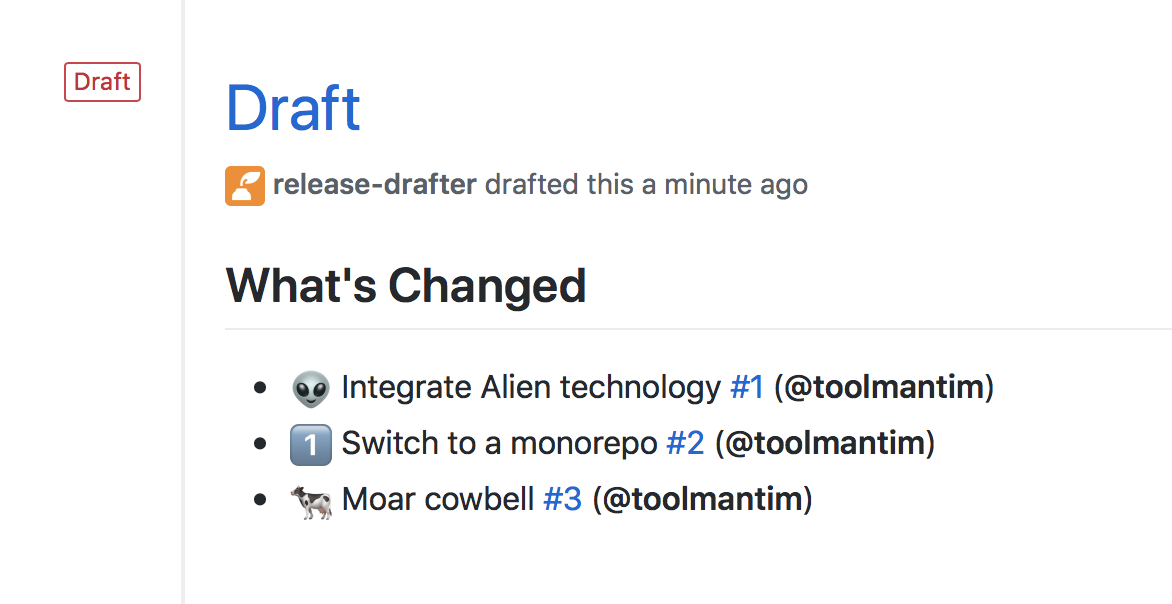
As pull requests are merged, a draft release is kept up-to-date listing the changes, ready to publish when you’re ready.
Configuration options
You can configure Release Drafter using the following key in your .github/release-drafter.yml file:
| Key | Required | Description |
|---|---|---|
template |
Required | The template for the body of the draft release. Use template variables to insert values. |
change-template |
Optional | The template to use for each merged pull request. Use change template variables to insert values. Default: * $TITLE ($NUMBER) @$AUTHOR |
no-changes-template |
Optional | The template to use for when there’s no changes. Default: * No changes |
branches |
Optional | The branches to listen for configuration updates to .github/release-drafter.yml and for merge commits. Useful if you want to test the app on a pull request branch. Default is the repository’s default branch. |
Release Drafter also supports Probot Config, if you want to store your configuration files in a central repository. This allows you to share configurations between projects, and create a organization-wide configuration file by creating a repository named .github and file named release-drafter.yml.
Template variables
You can use any of the following variables in your template:
| Variable | Description |
|---|---|
$CHANGES |
The markdown list of pull requests that have been merged. |
$CONTRIBUTORS |
A comma separated list of contributors to this release (pull request authors, commit authors, and commit committers). |
$PREVIOUS_TAG |
The previous releases’s tag. |
Change Template variables
You can use any of the following variables in change-template:
| Variable | Description |
|---|---|
$NUMBER |
The number of the pull request, e.g. 42 |
$TITLE |
The title of the pull request, e.g. Add alien technology |
$AUTHOR |
The pull request author’s username, e.g. gracehopper |