Summary:
👋 Hello! Thanks for react-native, it’s a great project.

I was digging into the Android implementation in _ReactAndroid_ and noticed a couple typos in the documentation. I went through and tried to fix all the typos I could find using [aspell](http://aspell.net).

Not applicable: these changes are only to comments, and CI should be skipped.

[ANDROID][ENHANCEMENT][*] - Correct comment and docblock typos
Closes https://github.com/facebook/react-native/pull/17049

Differential Revision: D6472182

Pulled By: shergin

fbshipit-source-id: 7e62cab118609596b483d1cf16c3abf651d6753b
Summary:
Previously, only form-data request bodies emitted upload progress updates. Now,
other request body types will also emit updates.
Addresses issues:
https://github.com/facebook/react-native/issues/15724https://github.com/facebook/react-native/issues/11853
This is a bug fix for functionality that's missing on Android. These events are already working correctly on iOS.
Run the following code on Android, and ensure that events are being sent:
```
const fileUri = 'file:///my_file.dat';
const url = 'http://my_post_url.com/';
const xhr = new XMLHttpRequest();
xhr.upload.onprogress = (event) => {
console.log('progress: ' + event.loaded + ' / ' + event.total);
}
xhr.onreadystatechange = () => {if (xhr.readyState === 4) console.log('done');}
console.log('start');
xhr.open('POST', url);
xhr.send({ uri: fileUri }); // sending a file (wasn't sending progress)
xhr.send("some big string"); // sending a string (wasn't sending progress)
const formData = new FormData(); formData.set('test', 'data');
xhr.send(formData); // sending form data (was already working)
```
[ANDROID] [BUGFIX] [XMLHttpRequest] - Added progress updates for all XMLHttpRequest upload types
Previously, only form-data request bodies emitted upload progress updates. Now,
other request body types will also emit updates.
Addresses issues:
https://github.com/facebook/react-native/issues/15724https://github.com/facebook/react-native/issues/11853
Closes https://github.com/facebook/react-native/pull/16541
Differential Revision: D6325252
Pulled By: hramos
fbshipit-source-id: 4fe617216293e6f451e2a1af4fa872e8f56d4f93
Summary:
We noticed that on Android the lineHeight behaviour is different from iOS for built in fonts and custom fonts. The problem becomes visible when the lineHeight approaches the fontSize, showing a cut-off on the bottom of the TextView. This issue has been raised before in #10712. There is a mention of a PR with a fix in that issue, which has not been merged yet. This implementation is a less intrusive fix leaving the current lineHeight approach in place and fixing the discrepancy only.
This proposed change prioritises ascent over descent for reduction, making the lineHeight functionality behave identical to iOS.
There is no existing test covering the lineHeight property and its behaviour in the CustomLineHeightSpan. This PR contains new unit tests that covers the various scenario's for the lineHeight calculations.
The original behaviour, before the change can against these unit tests. The case that fails is `shouldReduceAscentThird`, which can be made to succeed on the old code by changing the asserts to:
```
assertThat(fm.top).isEqualTo(-5);
assertThat(fm.ascent).isEqualTo(-5);
assertThat(fm.descent).isEqualTo(-4);
assertThat(fm.bottom).isEqualTo(-4);
```
The unit test succeeds for the current implementation, which has the values for ascent and descent inverted.
Below screenshots show before, after and iOS:
BEFORE
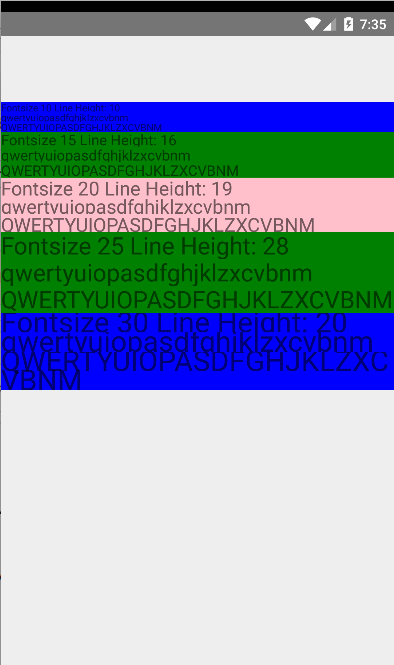
AFTER
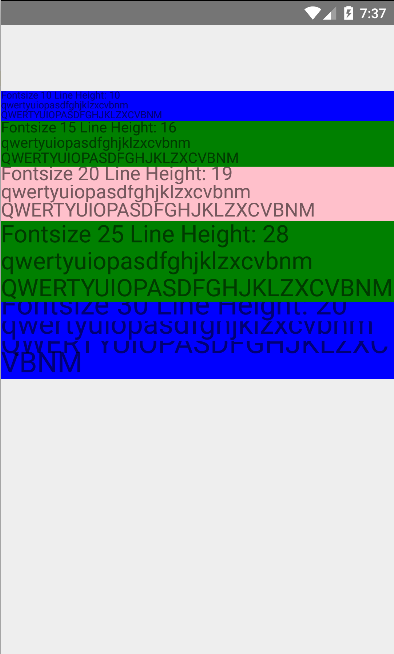
iOS
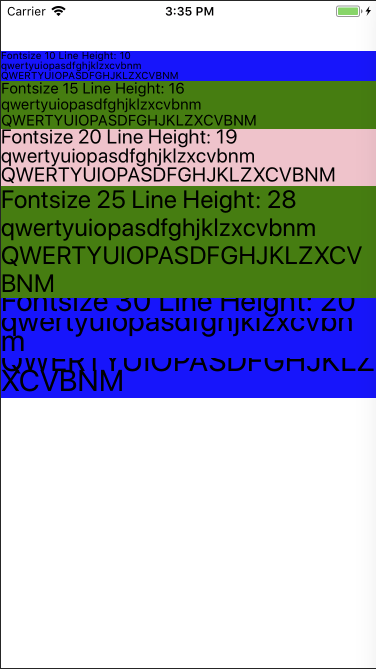
[ANDROID] [BUGFIX] [Text] - Fix the lineHeight behaviour on Android to match iOS
Closes https://github.com/facebook/react-native/pull/16448
Differential Revision: D6221854
Pulled By: andreicoman11
fbshipit-source-id: 7292f0f05f212d79678ac9d73e8a46bf93f1a7c6
Summary:
Rebased version of #12842 that was reverted because of failing fb internal tests.
Closes https://github.com/facebook/react-native/pull/15919

Differential Revision: D5823956

Pulled By: hramos

fbshipit-source-id: 4ece19a403f5ebbe4829c4c26696ea0575ab1d0e
Summary:
FIX#11142
This fixes#11142 and supersedes #11155 as I was unsure how to add/change commits in that PR.
Wrote up a bunch of unit tests for the ImageStore module. The added tests showed that there was indeed a problem with the flags used for the Base64OutputStream, and they also show that that has been fixed now.
Closes https://github.com/facebook/react-native/pull/13856
Differential Revision: D6017764
Pulled By: shergin
fbshipit-source-id: adf667dc722ddfe31449afd8cd20a0a192eacff6
Summary:
As I was working on mimicking iOS animations for my ongoing work with `react-navigation`, one task I had was to match the "push from right" animation that is common in UINavigationController.

I was able to grab the exact animation values for this animation with some LLDB magic, and found that the screen is animated using a `CASpringAnimation` with the parameters:

- stiffness: 1000
- damping: 500
- mass: 3

After spending a considerable amount of time attempting to replicate the spring created with these values by CASpringAnimation by specifying values for tension and friction in the current `Animated.spring` implementation, I was unable to come up with mathematically equivalent values that could replicate the spring _exactly_.

After doing some research, I ended up disassembling the QuartzCore framework, reading the assembly, and determined that Apple's implementation of `CASpringAnimation` does not use an integrated, numerical animation model as we do in Animated.spring, but instead solved for the closed form of the equations that govern damped harmonic oscillation (the differential equations themselves are [here](https://en.wikipedia.org/wiki/Harmonic_oscillator#Damped_harmonic_oscillator), and a paper describing the math to arrive at the closed-form solution to the second-order ODE that describes the DHO is [here](http://planetmath.org/sites/default/files/texpdf/39745.pdf)).

Though we can get the currently implemented RK4 integration close by tweaking some values, it is, the current model is at it's core, an approximation. It seemed that if I wanted to implement the `CASpringAnimation` behavior _exactly_, I needed to implement the analytical model (as is implemented in `CASpringAnimation`) in `Animated`.

We add three new optional parameters to `Animated.spring` (to both the JS and native implementations):

- `stiffness`, a value describing the spring's stiffness coefficient
- `damping`, a value defining how the spring's motion should be damped due to the forces of friction (technically called the _viscous damping coefficient_).
- `mass`, a value describing the mass of the object attached to the end of the simulated spring

Just like if a developer were to specify `bounciness`/`speed` and `tension`/`friction` in the same config, specifying any of these new parameters while also specifying the aforementioned config values will cause an error to be thrown.

~Defaults for `Animated.spring` across all three implementations (JS/iOS/Android) stay the same, so this is intended to be *a non-breaking change*.~

~If `stiffness`, `damping`, or `mass` are provided in the config, we switch to animating the spring with the new damped harmonic oscillator model (`DHO` as described in the code).~

We replace the old RK4 integration implementation with our new analytic implementation. Tension/friction nicely correspond directly to stiffness/damping with the mass of the spring locked at 1. This is intended to be *a non-breaking change*, but there may be very slight differences in people's springs (maybe not even noticeable to the naked eye), given the fact that this implementation is more accurate.

The DHO animation algorithm will calculate the _position_ of the spring at time _t_ explicitly and in an analytical fashion, and use this calculation to update the animation's value. It will also analytically calculate the velocity at time _t_, so as to allow animated value tracking to continue to work as expected.

Also, docs have been updated to cover the new configuration options (and also I added docs for Animated configuration options that were missing, such as `restDisplacementThreshold`, etc).

Run tests. Run "Animated Gratuitous App" and "NativeAnimation" example in RNTester.
Closes https://github.com/facebook/react-native/pull/15322

Differential Revision: D5794791

Pulled By: hramos

fbshipit-source-id: 58ed9e134a097e321c85c417a142576f6a8952f8
Summary:
Abstract class `ReactBaseTextShadowNode` was decoupled from `ReactTextShadowNode` to separate two goals/roles:
 * `ReactBaseTextShadowNode` represents spanned `<Text>` nodes, which can bear text attributes (both `RCTText` and `RCTVirtualText`);
 * `ReactTextShadowNode` represents anchor `<Text>` view in Yoga terms, which can bear layout attributes (`RCTText` and `RCTTextInput`).

`ReactVirtualTextShadowNode` now inherits `ReactBaseTextShadowNode`.
The same architectural changes was applited to view managers.

Why?
 * This is just a better architecture which represents the nature of this objects.
 * Bunch of "negative" logic which turn off excessive features for some suclasses was removed.
 * Memory efficiency.
 * Now we can improve `<TextInput>` component using right inheritance. Yay!

Reviewed By: achen1

Differential Revision: D5715830

fbshipit-source-id: ecc0764a03b5b7586fe77ad31f149cd840f4da41
Summary:
…ndroid
Android overrides the original set ime option when the EditText is a multiline one.
This change makes sure to set it back to the original one when blurOnSubmit is true,
which causes the button icon to be conforming to the set returnKeyType as well as
changing the behaviour of the button, such that it will blurOnSubmit correctly.
The reason not do it with blurOnSubmit being false is
because it then would not create new lines when pressing the submit button,
which would be inconsistent with IOS behaviour.
**Note** this change relies on this one #11006 because the app would crash if we don't expllicitly remove the focus (`editText.clearFocus();`)
Fixes#8778
**Test plan (required)**
1. Create view with TextInput with multiline and blurOnSubmit set to true
```javascript
<View>
<TextInput
returnKeyType='search'
blurOnSubmit={true}
multiline={true}
onSubmitEditing={event => console.log('submit search')}></TextInput>
</View>
```
2. Input some text and click submit button in soft keyboard
3. See submit event fired and focus cleared / keyboard removed
Closes https://github.com/facebook/react-native/pull/11125
Differential Revision: D5718755
Pulled By: hramos
fbshipit-source-id: c403d61a8a879c04c3defb40ad0b6689a2329ce1
Summary:
This PR fixes an issue with rotation decomposition matrix on android.
The issue can be illustrated with this sample code https://snack.expo.io/r1SHEJpVb
It surfaces when we have non-zero rotation in Y or X axis and when rotation Z is greater than 90deg or less than -90deg. In that case the decomposition code doesn't give a valid output and as a result the view gets rotated by 180deg in Z axis.
You may want to run the code linked above on android and iOS to see the difference. Basically the example app renders first image rotated only by 89deg and the next one by 91deg. As a result you should see the second view being pivoted just slightly more than the first image. Apparently on android the second image is completely flipped:
iOS:

Android:

The bug seemed to be caused by the code that decomposes the matrix into axis angles. It seems like that whole code has been overly complicated and we've been converting matrix first into quaternion just to extract angles. Whereas it is sufficient to extract angles directly from rotation matrix as described here: http://nghiaho.com/?page_id=846
This formula produces way simpler code and also gives correct result in the aforementioned case, so I decided not to debug quaternion code any further.
sidenote: New formula's y angle output range is now -90 to 90deg hence changes in tests.
Closes https://github.com/facebook/react-native/pull/14888
Reviewed By: astreet
Differential Revision: D5414006
Pulled By: shergin
fbshipit-source-id: 2e0a68cf4b2a9e32f10f6bfff2d484867a337fa3
Summary: It's now unnecessary to declare which JS modules you want to expose on your package. To upgrade, remove all overrides of `createJSModules` and keeping calling your JS modules as before.

Reviewed By: AaaChiuuu

Differential Revision: D5229259

fbshipit-source-id: 1160826c951433722f1fe0421c1200883ba1a348
Summary:
Corresponding iOS PR: #12275
Respect the withCredentials XMLHttpRequest flag for sending cookies with requests. This can reduce payload sizes where large cookies are set for domains.
This should fix#5347.
This is a breaking change because it alters the default behavior of XHR. Prior to this change, XHR would send cookies by default. After this change, by default, XHR does not send cookies which is consistent with the default behavior of XHR on web for cross-site requests. Developers can restore the previous behavior by passing `true` for XHR's `withCredentials` argument.
**Test plan (required)**
Verified in a test app that XHR works properly when specifying `withCredentials` as `true`, `false`, and `undefined`. Also, my team uses this change in our app.
Adam Comella
Microsoft Corp.
Closes https://github.com/facebook/react-native/pull/12276
Differential Revision: D4673646
Pulled By: ericvicenti
fbshipit-source-id: 924c230c9df72071b3cf9151c3ac201905ac28a5
Summary:
* Any animation can be looped on the javascript thread
* Only basic animations supported natively at this stage, loops run
using the native driver cannot contain animations of type sequence,
parallel, stagger, or loop

Motivation: We need a spinner in our app that is displayed and animated while the javascript thread is tied up with other tasks. This means it needs to be offloaded from the javascript thread, so that it will continue to run while those tasks are churning away.

I originally submitted PR #9513, which has served our needs, but brentvatne pointed out a better way to do it. Had hoped his suggestion would be implemented by janicduplessis or another fb employee, but after 5 months I thought I'd give it another push.

I've put together an implementation that basically matches the suggested API. Let me know what you think, and whether others can pick it up from here and get it in to core.

Personal Motivation: I am leaving my current organisation on Feb 10th, so am trying to clean thing
Closes https://github.com/facebook/react-native/pull/11973

Differential Revision: D4704381

fbshipit-source-id: 42a2cdf5d53a7c0d08f86a58485f7f38739e6cd9
Summary:
This implements a loading banner like on iOS that shows the progress of the packager.

**Test plan**
- Tested that it displays similar messages as it does on iOS and also that is show the right message when waiting for the remote debugger.
- Tested that errors are still shown properly.
- Tested that it works with packagers that don't support multipart response (add && false in https://github.com/facebook/react-native/blob/master/packager/src/Server/MultipartResponse.js#L81).
- Run new unit tests.
- Tested that backgrounding / foregrounding the app hides / show the banner properly.
Closes https://github.com/facebook/react-native/pull/12674
Differential Revision: D4673638
Pulled By: mkonicek
fbshipit-source-id: b2a1163de3d0792cf481d7111231a065f80a9594
Summary:
Android API 15 still have 1.5~2.0% distribution (refer: [Dashboard - Android Developer](https://developer.android.com/ndk/guides/standalone_toolchain.html#creating_the_toolchain)).

React Native is a good tec but many companies cannot endure loose their consumer. [Choreographer](https://developer.android.com/reference/android/view/Choreographer.html) triggered UI operation is the only reason that React Native Android sdk use minSdkVersion 16, so we can use a backward solution **only in API 15**: [Handler](https://developer.android.com/reference/android/os/Handler.html).

In this PR, the biggest change is :

- Make core operation of ReactChoreographer to an interface: ReactUIDriver;
- Impl ReactUIDriver by Handler => UIDriverHandlerImpl, refactor ReactChoreographer to UIDriverChoreographerImpl;
- Let UIDriverFactory to choose which one impl would be in use. (Only use handler in api 15).
Closes https://github.com/facebook/react-native/pull/12396

Reviewed By: AaaChiuuu

Differential Revision: D4588399

Pulled By: astreet

fbshipit-source-id: 76408e53664314dd926e6a553cde6bafbd37779e
Summary:
cc astreet

The goal of this PR is to enable the buck module `uimanager` to depend on `modules/core` without introducing any dependency cycles.

PR #11008 relies on this PR. PR #11008 needs `uimanager` to depend on `modules/core` so that `uimanager` can fire events using `RCTDeviceEventEmitter` which is in `modules/core`.

This PR moved a number of classes and interfaces:
  - `com.facebook.react.modules.debug.DeveloperSettings` -> `com.facebook.react.modules.debug.interfaces.DeveloperSettings`
  - `com.facebook.react.devsupport.DevOptionHandler` -> `com.facebook.react.devsupport.interfaces.DevOptionHandler `
  - `com.facebook.react.devsupport.DevSupportManager` -> `com.facebook.react.devsupport.interfaces.DevSupportManager`
  - `com.facebook.react.devsupport.DevServerHelper.PackagerStatusCallback` -> `com.facebook.react.devsupport.interfaces.PackagerStatusCallback`
  - The class `com.facebook.react.devsupport.StackTraceHelper.StackFrame` was renamed to `StackFram
Closes https://github.com/facebook/react-native/pull/12329

Differential Revision: D4551160

Pulled By: astreet

fbshipit-source-id: 3a78443c4f30469b13ddfbdcc9bbef6af9e8381a






