Summary:
Currently if you invoke `fetch()` with an invalid URL ("aaa" for
example) you cannot catch the error in javascript since it's not
reported. Instead the entire app crashes.
Fixes#7436 and #18087
Hopefully.
<!--
Thank you for sending the PR! We appreciate you spending the time to work on these changes.
Help us understand your motivation by explaining why you decided to make this change.
You can learn more about contributing to React Native here: http://facebook.github.io/react-native/docs/contributing.html
Happy contributing!
-->
Fix using fetch on Android with user generated input.
Added relevant unit test
`./scripts/run-android-local-unit-tests.sh` all pass
[ANDROID] [BUGFIX] [fetch] - Allow "unexpected url" exception to be caught on Android when using fetch
<!--
Help reviewers and the release process by writing your own release notes
**INTERNAL and MINOR tagged notes will not be included in the next version's final release notes.**
CATEGORY
[----------] TYPE
[ CLI ] [-------------] LOCATION
[ DOCS ] [ BREAKING ] [-------------]
[ GENERAL ] [ BUGFIX ] [-{Component}-]
[ INTERNAL ] [ ENHANCEMENT ] [ {File} ]
[ IOS ] [ FEATURE ] [ {Directory} ] |-----------|
[ ANDROID ] [ MINOR ] [ {Framework} ] - | {Message} |
[----------] [-------------] [-------------] |-----------|
[CATEGORY] [TYPE] [LOCATION] - MESSAGE
EXAMPLES:
[IOS] [BREAKING] [FlatList] - Change a thing that breaks other things
[ANDROID] [BUGFIX] [TextInput] - Did a thing to TextInput
[CLI] [FEATURE] [local-cli/info/info.js] - CLI easier to do things with
[DOCS] [BUGFIX] [GettingStarted.md] - Accidentally a thing/word
[GENERAL] [ENHANCEMENT] [Yoga] - Added new yoga thing/position
[INTERNAL] [FEATURE] [./scripts] - Added thing to script that nobody will see
-->
Closes https://github.com/facebook/react-native/pull/18103
Differential Revision: D7097110
Pulled By: hramos
fbshipit-source-id: 69144e8a0f7404d9bcc7c71a94650de36a48c84a
Summary:
Includes React Native and its dependencies Fresco, Metro, and Yoga. Excludes samples/examples/docs.

find: ^(?:( *)|( *(?:[\*~#]|::))( )? *)?Copyright (?:\(c\) )?(\d{4})\b.+Facebook[\s\S]+?BSD[\s\S]+?(?:this source tree|the same directory)\.$
replace: $1$2$3Copyright (c) $4-present, Facebook, Inc.\n$2\n$1$2$3This source code is licensed under the MIT license found in the\n$1$2$3LICENSE file in the root directory of this source tree.

Reviewed By: TheSavior, yungsters

Differential Revision: D7007050

fbshipit-source-id: 37dd6bf0ffec0923bfc99c260bb330683f35553e
Summary:
This PR adds support for Animated tracking to Animated Native Driver implementation on Android and iOS.

Animated tracking allows for animation to be started with a "dynamic" end value. Instead of passing a fixed number as end value we can pass a reference to another Animated.Value. Then when that value changes, the animation will be reconfigured to drive the animation to the new destination point. What is important is that animation will keep its state in the process of updating "toValue". That is if it is a spring animation and the end value changes while the previous animation still hasn't settled the new animation will start from the current position and will inherit current velocity. This makes end value transitions very smooth.

Animated tracking is available in JS implementation of Animated library but not in the native implementation. Therefore until now, it wasn't possible to utilize native driver when using animated tracking. Offloading animation from JS thread turns out to be crucial for gesture driven animations. This PR is a step forward towards feature parity between JS and native implementations of Animated.

Here is a link to example video that shows how tracking can be used to implement chat heads effect: https://twitter.com/kzzzf/status/958362032650244101

In addition this PR fixes an issue with frames animation driver on Android that because of rounding issues was taking one extra frame to start. Because of that change I had to update a number of Android unit tests that were relying on that behavior and running that one additional animation step prior to performing checks.

As a part of this PR I'm adding three unit tests for each of the platforms that verifies most important aspects of this implementation. Please refer to the code and look at the test cases top level comments to learn what they do.

I'm also adding a section to "Native Animated Example" screen in RNTester app that provides a test case for tracking. In the example we have blue square that fallows the red line drawn on screen. Line uses Animated.Value for it's position while square is connected via tracking spring animation to that value. So it is ought to follow the line. When user taps in the area surrounding the button new position for the red line is selected at random and the value updates. Then we can watch blue screen animate to that position.

You can also refer to this video that I use to demonstrate how tracking can be linked with native gesture events using react-native-gesture-handler lib: https://twitter.com/kzzzf/status/958362032650244101

[GENERAL][FEATURE][Native Animated] - Added support for animated tracking to native driver. Now you can use `useNativeDriver` flag with animations that track other Animated.Values
Closes https://github.com/facebook/react-native/pull/17896

Differential Revision: D6974170

Pulled By: hramos

fbshipit-source-id: 50e918b36ee10f80c1deb866c955661d4cc2619b
Summary:
There seems to be a rounding error in the android code for line height, so that for some fonts and at some combinations of line height and font size the actual height of the elements seems to be slightly too short.
I've identified one issue that I mentioned here https://github.com/facebook/react-native/issues/10712#issuecomment-359382137 that could at least explain some of the problem. That when the line-height minus the original sum of the absolute value of top and bottom from the metrics, happens to be an odd number, the division by two causes a rounding error of 1, so that the actual line height is 1pt less than it should.
The fix uses floating point division instead of integer division, and rounds (arbitrarily) the negative values up and the positive values down so that the total is still the correct for odd numbers.
It turns out that only ascent and descent is used to give the actual line-height between lines in the same text-element. The top and bottom values are only used for padding the top and bottom of the text. So when the line-height is greater than the font size and the extra padding this PR sets the ascent and descent to the same value as the top and bottom respectively.
I've renamed the shouldIncreaseAllMetricsProportionally test to evenLineHeightShouldIncreaseAllMetricsProportionally and added an extra assertion to check that bottom-top still equals the line height.
Added another test oddLineHeightShouldAlsoWork that is similar but uses an odd number for the line height to test that it still works with odd numbers. This test only uses the sum of the values so that it's indifferent to what value the implementation chooses to round up or down.
Improvement on https://github.com/facebook/react-native/pull/16448
Fix line-height calculation on Android.
| Before | After |
| ------------- |-------------|
|  |  |
(All three columns have font size 16 and lineHeight: 32. The first one is has fixed height 9*32, the second is 9 Text elements, the last is one text element with lots of text limited to 9 lines, so they should be the same height. )
Closes https://github.com/facebook/react-native/pull/17952
Differential Revision: D6980333
Pulled By: hramos
fbshipit-source-id: 0a501358cfbf7f139fca46056d0d972b1daf6ae3
Summary:
Circle is currently failing on the `android` step due to a dependency issue introduced by the aforementioned PR. I am currently waiting for an internal diff to be reviewed which will restore this PR alongside the necessary dependency.
Closes https://github.com/facebook/react-native/pull/17902

Differential Revision: D6937173

Pulled By: hramos

fbshipit-source-id: f732a397521cc5df36f503e618318ef6d69aeaa6
Summary:
This PR includes the same changes made in #16541, for addressing issues #11853/#15724. It adds upload progress updates for uploads with any request body type, and not just form-data.

Additionally, this PR also includes a commit for fixing an `IllegalStateException` when a user's connection gets closed or times out (issues #10423/#11016). Since this exception was occurring within the progress updates logic, it started being thrown more frequently as a result of adding progress updates to all uploads, which was why the original PR was reverted.

To test the upload progress updates, run the following JS to ensure events are now being dispatched:
```
const fileUri = 'file:///my_file.dat';
const url = 'http://my_post_url.com/';
const xhr = new XMLHttpRequest();

xhr.upload.onprogress = (event) => {
    console.log('progress: ' + event.loaded + ' / ' + event.total);
}

xhr.onreadystatechange = () => {if (xhr.readyState === 4) console.log('done');}

console.log('start');

xhr.open('POST', url);

// sending a file (wasn't sending progress)
xhr.setRequestHeader('Content-Type', 'image/jpeg');
xhr.send({ uri: fileUri });

// sending a string (wasn't sending progress)
xhr.setRequestHeader('Content-Type', 'text/plain');
xhr.send("some big string");

// sending form data (was already working)
xhr.setRequestHeader('Content-Type', 'multipart/form-data');
const formData = new FormData(); formData.append('test', 'data');
xhr.send(formData);
```

To test the crash fix:
In the RN Android project, before this change, set a breakpoint at `mRequestBody.writeTo(mBufferedSink);` of `ProgressRequestBody`, and wait a short while for a POST request with a non-null body to time out before resuming the app. Once resumed, if the connection was closed (the `closed` variable will be set to true in `RealBufferedSink`), an `IllegalStateException` will be thrown, which crashes the app. After the changes, an `IOException` will get thrown instead, which is already being properly handled.

As mentioned above, includes the same changes as #16541, with an additional commit.

[ANDROID] [BUGFIX] [XMLHttpRequest] - Added progress updates for all XMLHttpRequest upload types / fix crash on closed connection

Previously, only form-data request bodies emitted upload progress updates. Now, other request body types will also emit updates. Also, Android will no longer crash on certain requests when user has a poor connection.

Addresses issues: 11853/15724/10423/11016
Closes https://github.com/facebook/react-native/pull/17312

Differential Revision: D6712377

Pulled By: mdvacca

fbshipit-source-id: bf5adc774703e7e66f7f16707600116f67201425
Summary:
This PR is a followup to https://github.com/facebook/react-native/pull/11417 and should be merged after that one is merged.
1. Add support for creating blobs from strings, not just other blobs
1. Add the `File` constructor which is a superset of `Blob`
1. Add the `FileReader` API which can be used to read blobs as strings or data url (base64)
1. Add support for uploading and downloading blobs via `XMLHttpRequest` and `fetch`
1. Add ability to download local files on Android so you can do `fetch(uri).then(res => res.blob())` to get a blob for a local file (iOS already supported this)
1. Clone the repo https://github.com/expo/react-native-blob-test
1. Change the `package.json` and update `react-native` dependency to point to this branch, then run `npm install`
1. Run the `server.js` file with `node server.js`
1. Open the `index.common.js` file and replace `localhost` with your computer's IP address
1. Start the packager with `yarn start` and run the app on your device
If everything went well, all tests should pass, and you should see a screen like this:
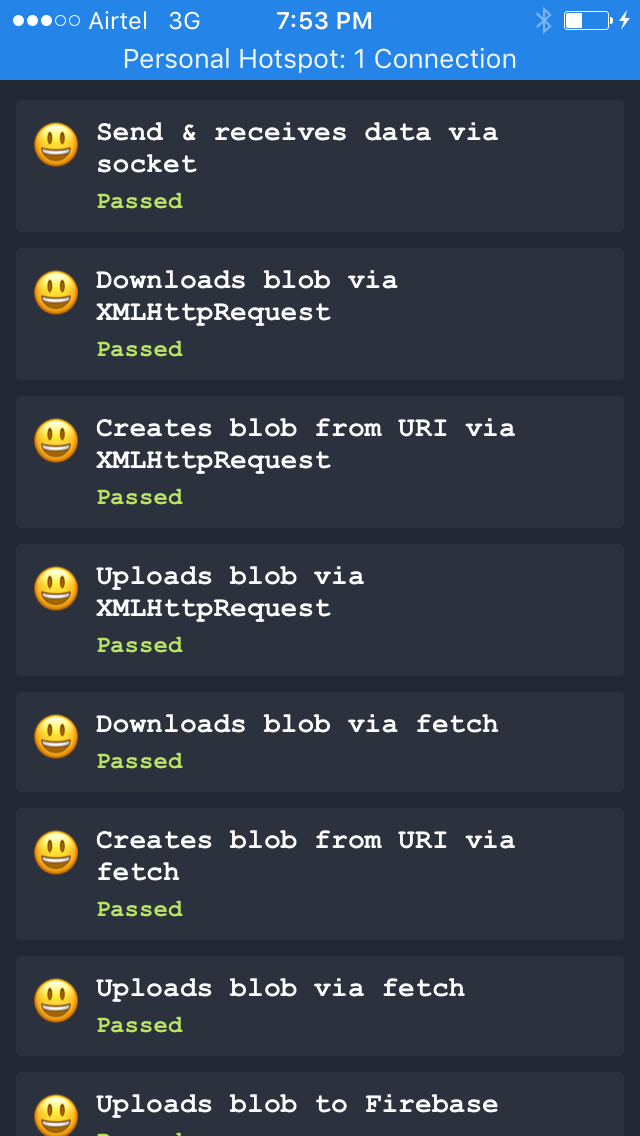!
Pull to rerun all tests or tap on specific test to re-run it
[GENERAL] [FEATURE] [Blob] - Implement blob support for XMLHttpRequest
Closes https://github.com/facebook/react-native/pull/11573
Reviewed By: shergin
Differential Revision: D6082054
Pulled By: hramos
fbshipit-source-id: cc9c174fdefdfaf6e5d9fd7b300120a01a50e8c1
Summary:
<!--
Thank you for sending the PR! We appreciate you spending the time to work on these changes.

Help us understand your motivation by explaining why you decided to make this change.

You can learn more about contributing to React Native here: http://facebook.github.io/react-native/docs/contributing.html

Happy contributing!

-->

Attempted fix for issue #17248

Added unit tests that cover the affected function and manually repeated the reproduction steps found in the issue.

Note: I had to apply the attached patch file to actually *run* the tests because they were not enabled. I didn't include this in the PR because it seemed like a secondary problem with possible ramifications (see comment near patched line) beyond this issue. For example, other, unrelated tests break when that line is uncommented.
[textInputTestEnable.patch.txt](https://github.com/facebook/react-native/files/1565807/textInputTestEnable.patch.txt)

If I should apply the patch to this PR or re-enable the tests in some other fashion, please let me know and I can do so.

(none)

<!--
Help reviewers and the release process by writing your own release notes

**INTERNAL and MINOR tagged notes will not be included in the next version's final release notes.**

  CATEGORY
[----------]        TYPE
[ CLI      ]   [-------------]      LOCATION
[ DOCS     ]   [ BREAKING    ]   [-------------]
[ GENERAL  ]   [ BUGFIX      ]   [-{Component}-]
[ INTERNAL ]   [ ENHANCEMENT ]   [ {File}      ]
[ IOS      ]   [ FEATURE     ]   [ {Directory} ]   |-----------|
[ ANDROID  ]   [ MINOR       ]   [ {Framework} ] - | {Message} |
[----------]   [-------------]   [-------------]   |-----------|

[CATEGORY] [TYPE] [LOCATION] - MESSAGE

 EXAMPLES:

 [IOS] [BREAKING] [FlatList] - Change a thing that breaks other things
 [ANDROID] [BUGFIX] [TextInput] - Did a thing to TextInput
 [CLI] [FEATURE] [local-cli/info/info.js] - CLI easier to do things with
 [DOCS] [BUGFIX] [GettingStarted.md] - Accidentally a thing/word
 [GENERAL] [ENHANCEMENT] [Yoga] - Added new yoga thing/position
 [INTERNAL] [FEATURE] [./scripts] - Added thing to script that nobody will see
-->

[ANDROID] [BUGFIX] [TextInput] - Fix an issue when swapping to and from the `'visible-password'` or `'phone-pad'` keyboard types.
Closes https://github.com/facebook/react-native/pull/17249

Differential Revision: D6713008

Pulled By: hramos

fbshipit-source-id: 85eeb5398748d48e59d33eb86d851fd02d587a31
Summary:
Fixes:
```
Fatal Exception: java.lang.RuntimeException: Failed to create String from JSON
       at com.facebook.react.bridge.queue.NativeRunnable.run(NativeRunnable.java)
       at android.os.Handler.handleCallback(Handler.java:739)
       at android.os.Handler.dispatchMessage(Handler.java:95)
       at com.facebook.react.bridge.queue.MessageQueueThreadHandler.dispatchMessage(MessageQueueThreadHandler.java:31)
       at android.os.Looper.loop(Looper.java:234)
       at com.facebook.react.bridge.queue.MessageQueueThreadImpl$3.run(MessageQueueThreadImpl.java:193)
       at java.lang.Thread.run(Thread.java:818)
```
JavaScriptCore is very strict about invalid UTF symbols.
So if you pass an invalid UTF-8 string to it the string will be decoded as an empty string.

The current implementation of progressive downloading for Android blindly cuts the response in 8KB chunks.
That could cause a problem in case the last symbol in the chunk is multi-byte.

To prevent it I added a class which determines if this is the case and cut the string in the appropriate place.
A remainder is prepended to the next chunk of data.

This should fix the root cause of this issue:
https://github.com/facebook/react-native/issues/10756
Closes https://github.com/facebook/react-native/pull/15295

Differential Revision: D6712570

Pulled By: hramos

fbshipit-source-id: f07fcf0f011c2133c8e860ceb0588a29d36d07fb
Summary:
👋 Hello! Thanks for react-native, it’s a great project.

I was digging into the Android implementation in _ReactAndroid_ and noticed a couple typos in the documentation. I went through and tried to fix all the typos I could find using [aspell](http://aspell.net).

Not applicable: these changes are only to comments, and CI should be skipped.

[ANDROID][ENHANCEMENT][*] - Correct comment and docblock typos
Closes https://github.com/facebook/react-native/pull/17049

Differential Revision: D6472182

Pulled By: shergin

fbshipit-source-id: 7e62cab118609596b483d1cf16c3abf651d6753b
Summary:
Previously, only form-data request bodies emitted upload progress updates. Now,
other request body types will also emit updates.
Addresses issues:
https://github.com/facebook/react-native/issues/15724https://github.com/facebook/react-native/issues/11853
This is a bug fix for functionality that's missing on Android. These events are already working correctly on iOS.
Run the following code on Android, and ensure that events are being sent:
```
const fileUri = 'file:///my_file.dat';
const url = 'http://my_post_url.com/';
const xhr = new XMLHttpRequest();
xhr.upload.onprogress = (event) => {
console.log('progress: ' + event.loaded + ' / ' + event.total);
}
xhr.onreadystatechange = () => {if (xhr.readyState === 4) console.log('done');}
console.log('start');
xhr.open('POST', url);
xhr.send({ uri: fileUri }); // sending a file (wasn't sending progress)
xhr.send("some big string"); // sending a string (wasn't sending progress)
const formData = new FormData(); formData.set('test', 'data');
xhr.send(formData); // sending form data (was already working)
```
[ANDROID] [BUGFIX] [XMLHttpRequest] - Added progress updates for all XMLHttpRequest upload types
Previously, only form-data request bodies emitted upload progress updates. Now,
other request body types will also emit updates.
Addresses issues:
https://github.com/facebook/react-native/issues/15724https://github.com/facebook/react-native/issues/11853
Closes https://github.com/facebook/react-native/pull/16541
Differential Revision: D6325252
Pulled By: hramos
fbshipit-source-id: 4fe617216293e6f451e2a1af4fa872e8f56d4f93
Summary:
We noticed that on Android the lineHeight behaviour is different from iOS for built in fonts and custom fonts. The problem becomes visible when the lineHeight approaches the fontSize, showing a cut-off on the bottom of the TextView. This issue has been raised before in #10712. There is a mention of a PR with a fix in that issue, which has not been merged yet. This implementation is a less intrusive fix leaving the current lineHeight approach in place and fixing the discrepancy only.
This proposed change prioritises ascent over descent for reduction, making the lineHeight functionality behave identical to iOS.
There is no existing test covering the lineHeight property and its behaviour in the CustomLineHeightSpan. This PR contains new unit tests that covers the various scenario's for the lineHeight calculations.
The original behaviour, before the change can against these unit tests. The case that fails is `shouldReduceAscentThird`, which can be made to succeed on the old code by changing the asserts to:
```
assertThat(fm.top).isEqualTo(-5);
assertThat(fm.ascent).isEqualTo(-5);
assertThat(fm.descent).isEqualTo(-4);
assertThat(fm.bottom).isEqualTo(-4);
```
The unit test succeeds for the current implementation, which has the values for ascent and descent inverted.
Below screenshots show before, after and iOS:
BEFORE
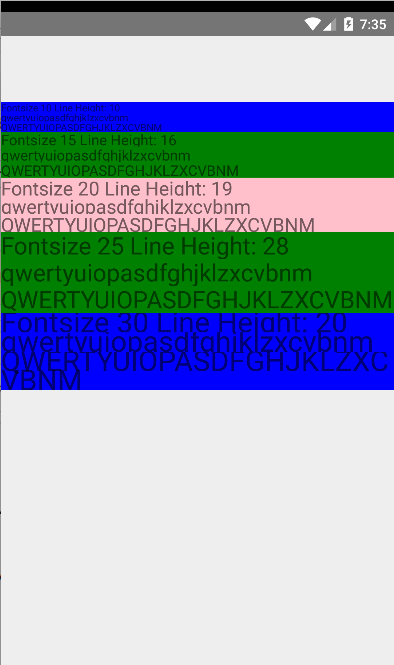
AFTER
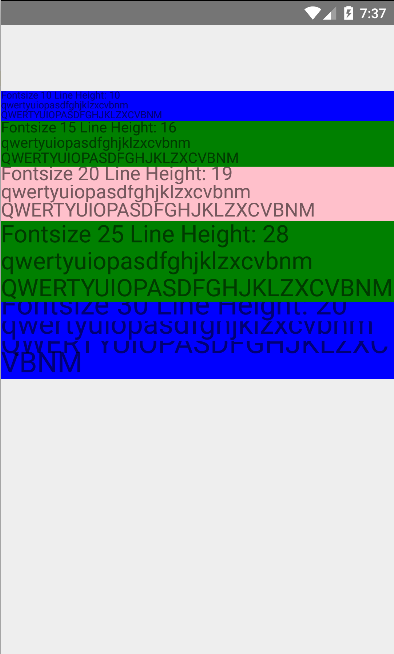
iOS
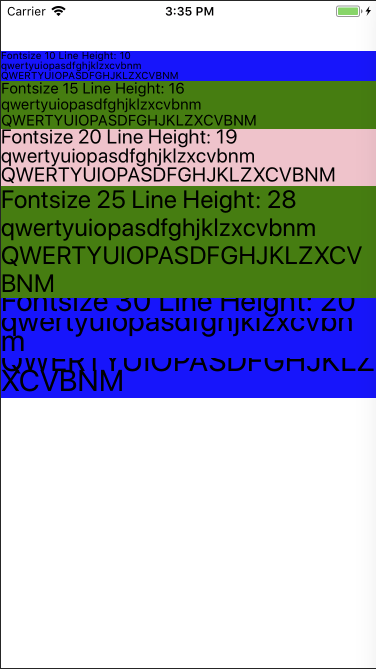
[ANDROID] [BUGFIX] [Text] - Fix the lineHeight behaviour on Android to match iOS
Closes https://github.com/facebook/react-native/pull/16448
Differential Revision: D6221854
Pulled By: andreicoman11
fbshipit-source-id: 7292f0f05f212d79678ac9d73e8a46bf93f1a7c6
Summary:
Rebased version of #12842 that was reverted because of failing fb internal tests.
Closes https://github.com/facebook/react-native/pull/15919

Differential Revision: D5823956

Pulled By: hramos

fbshipit-source-id: 4ece19a403f5ebbe4829c4c26696ea0575ab1d0e
Summary:
FIX#11142
This fixes#11142 and supersedes #11155 as I was unsure how to add/change commits in that PR.
Wrote up a bunch of unit tests for the ImageStore module. The added tests showed that there was indeed a problem with the flags used for the Base64OutputStream, and they also show that that has been fixed now.
Closes https://github.com/facebook/react-native/pull/13856
Differential Revision: D6017764
Pulled By: shergin
fbshipit-source-id: adf667dc722ddfe31449afd8cd20a0a192eacff6
Summary:
As I was working on mimicking iOS animations for my ongoing work with `react-navigation`, one task I had was to match the "push from right" animation that is common in UINavigationController.

I was able to grab the exact animation values for this animation with some LLDB magic, and found that the screen is animated using a `CASpringAnimation` with the parameters:

- stiffness: 1000
- damping: 500
- mass: 3

After spending a considerable amount of time attempting to replicate the spring created with these values by CASpringAnimation by specifying values for tension and friction in the current `Animated.spring` implementation, I was unable to come up with mathematically equivalent values that could replicate the spring _exactly_.

After doing some research, I ended up disassembling the QuartzCore framework, reading the assembly, and determined that Apple's implementation of `CASpringAnimation` does not use an integrated, numerical animation model as we do in Animated.spring, but instead solved for the closed form of the equations that govern damped harmonic oscillation (the differential equations themselves are [here](https://en.wikipedia.org/wiki/Harmonic_oscillator#Damped_harmonic_oscillator), and a paper describing the math to arrive at the closed-form solution to the second-order ODE that describes the DHO is [here](http://planetmath.org/sites/default/files/texpdf/39745.pdf)).

Though we can get the currently implemented RK4 integration close by tweaking some values, it is, the current model is at it's core, an approximation. It seemed that if I wanted to implement the `CASpringAnimation` behavior _exactly_, I needed to implement the analytical model (as is implemented in `CASpringAnimation`) in `Animated`.

We add three new optional parameters to `Animated.spring` (to both the JS and native implementations):

- `stiffness`, a value describing the spring's stiffness coefficient
- `damping`, a value defining how the spring's motion should be damped due to the forces of friction (technically called the _viscous damping coefficient_).
- `mass`, a value describing the mass of the object attached to the end of the simulated spring

Just like if a developer were to specify `bounciness`/`speed` and `tension`/`friction` in the same config, specifying any of these new parameters while also specifying the aforementioned config values will cause an error to be thrown.

~Defaults for `Animated.spring` across all three implementations (JS/iOS/Android) stay the same, so this is intended to be *a non-breaking change*.~

~If `stiffness`, `damping`, or `mass` are provided in the config, we switch to animating the spring with the new damped harmonic oscillator model (`DHO` as described in the code).~

We replace the old RK4 integration implementation with our new analytic implementation. Tension/friction nicely correspond directly to stiffness/damping with the mass of the spring locked at 1. This is intended to be *a non-breaking change*, but there may be very slight differences in people's springs (maybe not even noticeable to the naked eye), given the fact that this implementation is more accurate.

The DHO animation algorithm will calculate the _position_ of the spring at time _t_ explicitly and in an analytical fashion, and use this calculation to update the animation's value. It will also analytically calculate the velocity at time _t_, so as to allow animated value tracking to continue to work as expected.

Also, docs have been updated to cover the new configuration options (and also I added docs for Animated configuration options that were missing, such as `restDisplacementThreshold`, etc).

Run tests. Run "Animated Gratuitous App" and "NativeAnimation" example in RNTester.
Closes https://github.com/facebook/react-native/pull/15322

Differential Revision: D5794791

Pulled By: hramos

fbshipit-source-id: 58ed9e134a097e321c85c417a142576f6a8952f8
Summary:
Abstract class `ReactBaseTextShadowNode` was decoupled from `ReactTextShadowNode` to separate two goals/roles:
 * `ReactBaseTextShadowNode` represents spanned `<Text>` nodes, which can bear text attributes (both `RCTText` and `RCTVirtualText`);
 * `ReactTextShadowNode` represents anchor `<Text>` view in Yoga terms, which can bear layout attributes (`RCTText` and `RCTTextInput`).

`ReactVirtualTextShadowNode` now inherits `ReactBaseTextShadowNode`.
The same architectural changes was applited to view managers.

Why?
 * This is just a better architecture which represents the nature of this objects.
 * Bunch of "negative" logic which turn off excessive features for some suclasses was removed.
 * Memory efficiency.
 * Now we can improve `<TextInput>` component using right inheritance. Yay!

Reviewed By: achen1

Differential Revision: D5715830

fbshipit-source-id: ecc0764a03b5b7586fe77ad31f149cd840f4da41
Summary:
…ndroid
Android overrides the original set ime option when the EditText is a multiline one.
This change makes sure to set it back to the original one when blurOnSubmit is true,
which causes the button icon to be conforming to the set returnKeyType as well as
changing the behaviour of the button, such that it will blurOnSubmit correctly.
The reason not do it with blurOnSubmit being false is
because it then would not create new lines when pressing the submit button,
which would be inconsistent with IOS behaviour.
**Note** this change relies on this one #11006 because the app would crash if we don't expllicitly remove the focus (`editText.clearFocus();`)
Fixes#8778
**Test plan (required)**
1. Create view with TextInput with multiline and blurOnSubmit set to true
```javascript
<View>
<TextInput
returnKeyType='search'
blurOnSubmit={true}
multiline={true}
onSubmitEditing={event => console.log('submit search')}></TextInput>
</View>
```
2. Input some text and click submit button in soft keyboard
3. See submit event fired and focus cleared / keyboard removed
Closes https://github.com/facebook/react-native/pull/11125
Differential Revision: D5718755
Pulled By: hramos
fbshipit-source-id: c403d61a8a879c04c3defb40ad0b6689a2329ce1
Summary:
This PR fixes an issue with rotation decomposition matrix on android.
The issue can be illustrated with this sample code https://snack.expo.io/r1SHEJpVb
It surfaces when we have non-zero rotation in Y or X axis and when rotation Z is greater than 90deg or less than -90deg. In that case the decomposition code doesn't give a valid output and as a result the view gets rotated by 180deg in Z axis.
You may want to run the code linked above on android and iOS to see the difference. Basically the example app renders first image rotated only by 89deg and the next one by 91deg. As a result you should see the second view being pivoted just slightly more than the first image. Apparently on android the second image is completely flipped:
iOS:

Android:

The bug seemed to be caused by the code that decomposes the matrix into axis angles. It seems like that whole code has been overly complicated and we've been converting matrix first into quaternion just to extract angles. Whereas it is sufficient to extract angles directly from rotation matrix as described here: http://nghiaho.com/?page_id=846
This formula produces way simpler code and also gives correct result in the aforementioned case, so I decided not to debug quaternion code any further.
sidenote: New formula's y angle output range is now -90 to 90deg hence changes in tests.
Closes https://github.com/facebook/react-native/pull/14888
Reviewed By: astreet
Differential Revision: D5414006
Pulled By: shergin
fbshipit-source-id: 2e0a68cf4b2a9e32f10f6bfff2d484867a337fa3
Summary: It's now unnecessary to declare which JS modules you want to expose on your package. To upgrade, remove all overrides of `createJSModules` and keeping calling your JS modules as before.

Reviewed By: AaaChiuuu

Differential Revision: D5229259

fbshipit-source-id: 1160826c951433722f1fe0421c1200883ba1a348








